The Centre for Studies of Plural Societies (CSPS) hosted an enriching book talk on Hindu Bhakti through Muslim Eyes on 31 October 2025,featuring Dr. R. David Coolidge as the speaker, with Dr. Saad Mohammed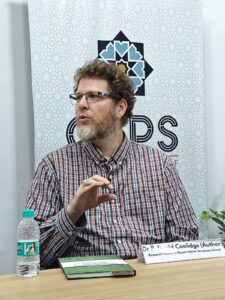 Ismail as the chair and Abin as the moderator. The session opened with Abin’s welcome and introduction to CSPS, the theme of the discussion, and Dr. Coolidge’s scholarly background, noting his unique contribution to understanding how Hindu Bhakti traditions are read and interpreted through a Muslim theological lens. Dr. Saad followed with an introduction to Dr. Coolidge’s recent book, which he had reviewed for the Oxford Journal of Hindu Studies, emphasizing the work’s significance in bridging Islamic and Hindu Studies—two disciplines that often remain academically distant—and its crucial relevance for plural societies such as India. He highlighted the book as a rare example of comparative theology that speaks meaningfully both within and beyond the academy.
Dr. Coolidge then traced the intellectual and personal journey that shaped this project, beginning from his conversion to Islam in 1998, followed by years of classical Islamic learning, Arabic study, and work with Muslim communities in the United States. His graduate training in Sanskrit, Indian philosophy, and Yogadarśana led him toward Krishna Bhakti traditions, particularly Chaitanya Vaishnavism, a tradition that emerged during the Bengal Sultanate and developed in deep conversation with the Muslim lifeworld.
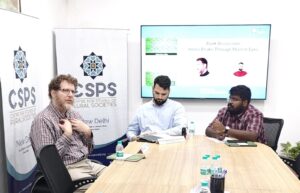
Dr. Coolidge discussed encounters such as those between Chaitanya and the Chan Kazi and highlighted the inclusive devotional presence of figures like Haridas, born to a Muslim family, as examples of the tradition’s openness. He elaborated on the theological and literary foundations of Chaitanya Vaishnavism, referencing texts such as the Bhagavad Gita, Gita Govinda, Bhaktirasamritasindhu, and the Chaitanya Charitamrita, and explained how these teachings have become global, particularly through ISKCON’s efforts across Europe and North America. In response to Dr. Saad’s questions on comparative method, Dr. Coolidge explained that his work combines theological training with academic rigour, beginning from lived practice (orthopraxy) rather than abstract definitions of “essence.” He emphasized that meaningful comparison must begin with shared empirical realities—the bodies we inhabit, the worlds we share, and the ethical conditions under which all humans live.
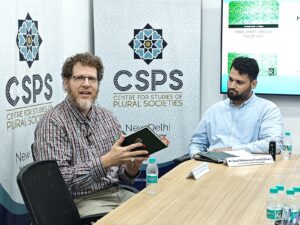
He illustrated this with examples from Islamic devotional life, such as the Hajj, and cross-cultural devotional overlaps visible in Bengali biographies of the Prophet and shared motifs between Islamic and Hindu devotional communities. During the audience interaction, he argued that devotional theism forms a common ground between Islam, Christianity, and Hinduism, and shared contemporary examples of interreligious encounter, such as ISKCON practitioners in Cairo and an Iranian disciple who embraced Sufi Islam. Responding to a question about his position as a White American Muslim, he reflected on conversion, vulnerability, and the importance of genuine encounter, noting that religious understanding emerges not from theoretical distance but from relational engagement—similar to how the Ras-Leela in Chaitanya theology symbolizes a dance of profound relationality.
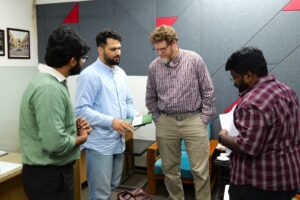 He concluded with reflections on debates between Advaita Vedanta and Chaitanya theology, observing that theological disagreements themselves reveal the depth and passion of devotional reasoning, sometimes requiring the humility to “sit and watch” rather than impose conclusions. The event closed with appreciation for the depth and sensitivity of Dr. Coolidge’s scholarship and the rich dialogue it generated, reaffirming CSPS’s commitment to fostering critical, pluralistic, and intellectually grounded conversations across traditions.