Abstract:
This essay examines how Dalit, Bahujan, and Indigenous food practices migrate online to form what I term digital kitchens – decentralized counter-public spaces where tastes once marked as “dirty” re-enter circulation. Drawing on the works of visual artist Rajyashri Goody, theatre practitioner Sri Vamsi Matta, Bahujan designer @TheBigFatBao, and Indigenous mukbang creators from Northeast India, the essay examines how food becomes a site of memory, protest, and embodied politics, mobilizing Dalit consciousness and tribal epistemologies. Drawing on Nancy Fraser’s and Catherine Squires’ theories of “counter-publics” and Dolly Kikon’s critique of “dirty food,” the essay argues that digital kitchens function as living archives that reclaim sensory, nutritional, and political ways of knowing that have long been excluded from the national imagination. In bridging counter-hegemony and algorithmic capture, these digital kitchens imagine a more plural table – where solidarity, technology, and ancestral knowledge coexist.
1.1. Introduction
When pork belly is prepared with anishi (smoked yam leaf) in a Naga migrant’s small apartment in Bangalore, and a pot of rakti (goat blood stew) cooks in a Dalit kitchen in Latur, they may appear as two disparate dishes with nothing in common. However, upon closer examination, both bear the identical weight of stigma that lingers around. Both reek of an unceremonious, unrefined, and ‘unclean’ to those who believe taste and kitchens should remain pristine. In the city, the pork stew has to conceal its smoke behind a shut kitchen door to prevent the landlord from complaining about ‘dirty smells.’ The rakti should be consumed discreetly to prevent the aroma from drifting into the neighbor’s window. These culinary items are rarely found in popular imagination, never featured on menus or in cookbooks; they persist as remnants of how certain gastronomic affiliations and belongings are overlooked in the nationalist food imagination. However, these identical flavours, which are composed of gastronomic grammar rooted in meat-eating practices and fermentation, are now taking different routes to reach the popular imagination. It is through the Digital Kitchen. By digital kitchen, I refer to the dispersed yet interconnected spaces where Dalit, Bahujan, and Indigenous food practices migrate online – through reels, recipe forwards, mukbangs, or multimedia art and interactive theatre.
Unlike glossy gastronomy, the digital kitchen functions as a grassroots counter-archive, preserving tastes born of stigma, scarcity, and survival, insisting that these flavours are not shameful but rather a form of knowledge. The digital kitchen leaks them out in small, persistent ways. It becomes a space where Dalit, Bahujan, and Indigenous food practices, long erased from the nationalist imagination, leak back into circulation.
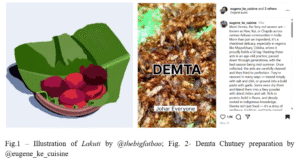
Fig.1 – Illustration of Lakuti by @thebigfatbao; Fig. 2- Demta Chutney preparation by @eugene_ke_cuisine
A plate of Lakuti (see Figure 1) and ngari curry appear in a YouTube mukbang on a migrant student’s feed in Delhi. An Instagram reel showcasing how to make demta chutney (red ant chutney, see Figure 2), celebrating Indigenous tastes and foraged knowledge that was once dismissed as uncivilised. What was once hidden slips through in fragments: taste crossing the boundaries of caste, class, and satvik dining. Each leak reminds us that through the digital public sphere, these overlooked flavours and identities are documented, historicized, and passed on, creating an alternative ecosystem of knowledge. In multi-modal gallery archives, a YouTube or Instagram reel, an E-cookbook recipe – these tastes carry memories of survival. One would not find these recipes in celebrity cookbooks or urban cafés. They remain invisible and obliterated from the nationalist imagination of what India eats.
Obliterated from the nationalist imagination of what India eats, these flavours have long been forced to hide behind closed doors, backyard walls, or cramped hostel kitchens. Dolly Kikon (2020) rightly reminds us that much of what is called “dirty food” – smoked pork, fermented chutneys, foraged insects, and goat blood stews – is not inherently dirty, but rather made so by dominant taste regimes. She shows how the smell of bamboo shoots or dried fish, for example, is policed in urban hostels, while the same ingredients hold deep ancestral knowledge in the indigenous kitchens of Northeast India.
Dirty, here, is not about hygiene but about power: who gets to decide what taste belongs at the centre of the national plate.
Today, however, that leaking has moved online, and it is not just nostalgia or culinary curiosity but what Nancy Fraser (1990) describes as a ‘counter-public’ act. When dominant publics shut certain tastes, smells, and stories out, the marginalised do not disappear; they make new spaces where what is unspeakable elsewhere can circulate on their own terms.
Catherine Squires (2002) pushes this idea further, reminding us that not every hidden kitchen wants to stand fully in the spotlight. Some stay as enclaves, holding taste and memory close within family walls. Others step out as counter-publics, pushing Dalit and Indigenous food into wider debates. Still others drift like satellites, crossing in and out of the mainstream culinary conversation as they choose. Dalit and Indigenous kitchens have long done all three. What was once confined to courtyards and tenements now leaks through YouTube mukbangs, Instagram Reels, and WhatsApp recipe forwards – small signals that what Brahminical cookbooks once labelled ‘dirty’ is, in fact, a living record of survival knowledge. Through the following case studies, we shall investigate how food, memory, and technology intersect in digital kitchens.
1.2. Vamsi’s Potluck Theatre 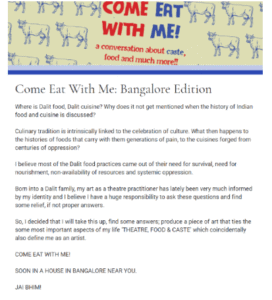
Technology here does more than circulate recipes; it historicizes kitchens once forced to forget themselves. The digital leak foregrounds the act of politicizing food. This is why, when dirty food goes online, it matters: it does not just feed hunger, it feeds a different public, one woven together by stories of shame, taste, improvisation, and the refusal to be forgotten. One of the distinct and interesting ways food marked as ‘dirty’ leaks across caste lines today is when it leaves the kitchen and steps onto a kitchen-turned-stage, where the invites are sent virtually. Vamsi, a theatre artist based in Bengaluru, uses his culinary-themed performance Come Eat With Me to create a counter-public that combines the stage with the act of cooking and eating (see Fig. 3 for his E-invite). He grew up in a Dalit family, where eating well often meant turning scraps into something that could stretch: goat blood stew, dried fish, bitter greens foraged when there was nothing else. For him, food has always been more than taste; it carries memory, quiet defiance, and old shame that refuses to disappear.
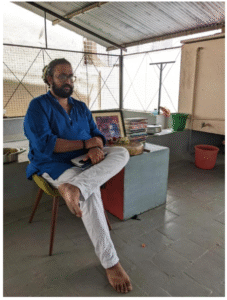 In his interactive performances of Come Eat With Me, Vamsi invites participants to bring dishes that carry their own intimate stories – meals their mothers or kin prepared in cramped kitchens, recipes born of absence, scarcity, and improvisation. The stage is set with a portrait of Ambedkar, anti-caste texts and pamphlets (see Fig. 4), and battered cooking pots, transforming the performance into a kitchen of memory and protest (Punyashloka, 2022). What unfolds is more than cooking: it is a narrative interwoven with personal anecdotes, recipes, folk stories, and creative expressions rooted in decolonial and Indigenous praxis. The audience joins in a collective feast accompanied by poetry recitations and conversations that surface shared grief, shame, and resilience. By the end, the shared meal becomes more than sustenance – it becomes a dialogue, a counter-public space where Dalit culinary legacies are celebrated as historical and Dalit subjectivities are reimagined as a collective strength.
1.3. Rajyashri Goody’s Visual Arts Practice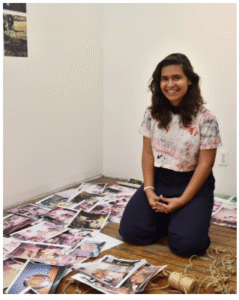
Rajyashri Goody relies on a multimodal combination of analogue photographs, archival excerpts, literary references, handwritten scraps, and everyday kitchen objects to illustrate how food and caste are intricately entwined. In her visual arts project, Eat With Great Delight, which was first exhibited at the Clark House Initiative (see Fig. 5), Goody displayed photographs drawn from her own family’s everyday life: her newlywed mother sipping a glass of Maaza, an aunt passing around cake and wafers on paper plates, her brother learning to hold a fork for the first time. These simple, ordinary moments challenge a dominant gastronomic imagination that tends to remember Brahminical kitchens as sites of abundance, while Dalit kitchens are characterized by a sense of paucity, hunger, and suffering (Deboo, 2023). Goody stitches the family photographic archive with lines from Dalit writers who described hunger, leftover scraps, shame, and the small acts of turning cast-off food into something worth eating. She borrows the nomenclature of the project from Omprakash Valmiki’s Joothan (2003), which recounts how Dalit families once lived off the scraps left behind by the upper castes. By turning these scraps into recipes, she turns slander into counter-memory and a form of record-keeping. Dalit cookbooks are rare, but Goody shows that Dalit autobiographical writing is already a kind of recipe book in disguise: notes about dried fish, goat’s head stew, sugarcane sweets, and the smell of dry fish drifting through cramped, rented rooms. Since 2017, she has been piecing these fragments together, creating an archive that challenges what Sharmila Rege (1998) referred to as the “official forgetting” of caste.
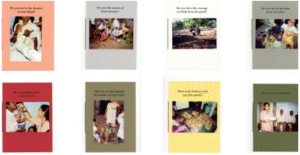
Fig. 6- Eat with Great Delight (http://www.rajyashrigoody.com/eat-with-great-delight )
In conjunction with her Ambedkarite art installations, Rajyashri Goody interrogates how everyday modes of sustenance – such as access to food and water in
public spaces – have historically been denied to Dalit 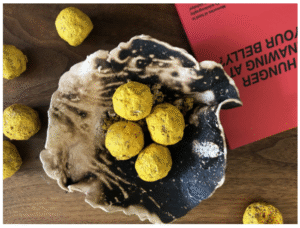 citizens. These dehumanising exclusions enact what can be described as a form of constitutional ontocide, erasing Dalit life-worlds from both civic rights and historical memory. In her 2018 exhibition Revelations at Harvard, Goody created laddoos out of the pulp of the Manusmriti (see Fig. 7), the Hindu text that codified the varna system and sanctioned caste-based segregation. These sweets were sculpted from the very text that dictated who could own land to cultivate and farm, who could consume dead carcasses, and whose histories were worth recording. By pulping a scripture that had long been weaponized to police caste minorities and reshaping it into something edible, Goody reclaims it as a tool of resistance. In doing so, she follows the intellectual and political footsteps of B.R. Ambedkar by dismantling caste-based worldviews and affirming caste as a lived, embodied reality.
Her practice extends further into installations, such as “Is the Water Chavdar?”, a ceramic landscape that recalls the historic Mahad Satyagraha, when Dalits asserted their right to draw water from the Chavdar public tank. These artworks, when photographed, scanned, printed, circulated, and shared online, evoke or embody a distinct sense of Dalit ontology grounded in survival and defiance. When Goody’s ladddos or ceramic landscapes with autobiographical notes, sensory investigations, and Dalit memories enter the Digital Kitchen, they are historicized as political claims. In this sense, Dalit ontology becomes not just survival knowledge but a framework for remembering, imagining, and demanding a plural table that can accommodate an alternative Dalit historiography.
1.4. The Big Fat Bao’s Dalit Cyber-Historiography
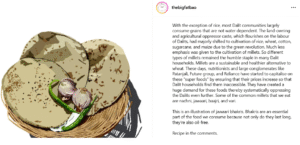
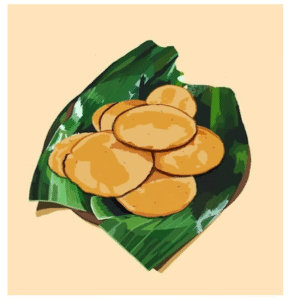 Adding to Vamsi’s and Goody’s multimedia performances and photographic exhibitions, The Big Fat Bao’s caste-conscious world is built from posts and pixels. A young Bahujan designer, she uses her Instagram handle, @thebigfatbao, to stitch together what she calls a Dalit cyber-historiography – a visual archive of Dalit food, illustrated recipes, and notes on nutrition that reveal how caste seeps into the everyday act of cooking. Their posts ask sharp questions: Who gets to eat well? Who eats what is left? And who decides what counts as respectable food at all? In each post, she highlights what many choose to ignore that Dalit kitchens often survive through quick fixes, scraps, and leftovers others discard, and chipped plates and spoons that never appear in elite publication cookbooks or influencer kitchens or big-budget food shows: rakti made from goat’s blood, pumpkin syrup, sweet pumpkin fritters called kakdiche gharge (see Fig. 8: @thebigfatbao), leafy rolls called bhanore, poha soaked and eaten in a rush, jawari bharris, roasted jackfruit seeds, a simple egg roast, and ratha poriyal cooked from leftover bits. For her, each drawing or graphic helps record Dalit food traditions and highlights how questions of nutrition and life expectancy are tied to what people eat.
Their digital practice confronts two interlinked terrains of struggle. The first is nutritional and biopolitical. By annotating recipes with nutritional value and linking them to life expectancy, she insists that questions of caste and food are not only cultural but bodily. The cheap grains and discarded cuts that Dalit families rely on are also linked to patterns of malnutrition, ill health, and shortened life spans (see Fig. 9: @thebigfatbao). Her graphics thus do more than historicize Dalit kitchens; they investigate how structural violence enters the body through rationing, scarcity, and stigma. What polite cookbooks erase as “unrefined” is in fact survival knowledge that has kept communities alive, albeit at profound physical cost. In this sense, The Big Fat Bao’s feed becomes a record of the intimate ties between caste, hunger, and health, a counter-archive that treats the body itself as a site of caste politics.
The second terrain is digital and infrastructural. Instagram, as a corporate platform, thrives on aesthetic consumption, novelty, and algorithmic circulation. The danger is that posts meant as political interventions – blood curry illustrated in bright palettes, notes on nutrition set in neat grids – risk being depoliticized, aestheticized, or even appropriated as spectacle divorced from their histories of exclusion. This is the paradox of the digital leak: while platforms allow marginalized kitchens to speak back, they also capture these voices in economies of attention where hashtags and likes often flatten differences. In this sense, The Big Fat Bao’s work walks a fine line between visibility and co-option. Their refusal to glamorize food and her insistence on linking each post to caste and health are efforts to resist that flattening, keeping the Dalit kitchen firmly rooted in politics rather than performance.
A Dalit cyber-historiography, such as The Big Fat Bao’s, performs the work of counter-publics by building archives that resist Brahminical erasures and placing nutrition, health, and caste politics at the centre of food discourse. Their graphics ask followers not only to look, but to account: to see how caste operates in their own kitchens, on their plates, and in their privileges. Their work reminds us that digital kitchens are never only about sharing food; they are about negotiating with infrastructures that thrive on erasure while still carving out spaces of memory, protest, and embodied knowledge.
The digital leak goes beyond merely displaying what individuals consume; it serves as a method for monitoring, documenting, and sharing what was previously kept discreetly in personal kitchens. For numerous Dalit artists and creators, technology serves as a dynamic archive: a means to document recipes, methods, and survival narratives that seldom find their way into mainstream cookbooks or culinary records. Every post, reel, or video reintroduces these flavours into shared remembrance, transforming simple remnants and solutions into a documentation of how whole communities nourished themselves in the face of stigma, rationing, or embarrassment.
1.5. Vernacular Mukbang from Borderlands of Northeast India
This digital leak occurs in the hills of Manipur, Nagaland, and Mizoram, too, not through digitized galleries or installations, but through mukbang clips. Indigenous mukbang creators, such as Kent’s Vlog or Smake, film themselves on YouTube eating smoked pork, fermented bamboo shoots, sticky rice, or wild greens foraged from the kitchen gardens or farms. These mukbang videos, facilitated through Web 2.0, are shared across indigenous borderland communities, including the migrants, who once had to hide these smells in metropolitan city hostels. What appears to be a casual meal on YouTube becomes a small act of resistance. These meals, once dismissed as unclean or unrefined, with their sharp smells policed, now drift across screens, carrying the pungent taste of bamboo shoots or dry fish through digital corridors that polite food media rarely touches. 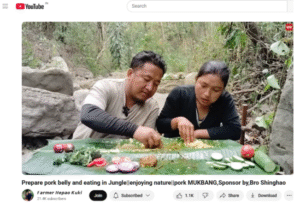
Manem Mamou, Smake, and Bite of Naga are producing mukbang videos, with a strong emphasis on eating as both a spectacle and a situated ritual. Through close-up camera angles and ASMR audio, they highlight the textual and sonic dimensions of indigenous cuisine. Smake, a Mizo mukbang channel, often features solitary eating sessions in domestic or village settings. The meals shown in his mukbangs are typically significant and contextual to the indigenous communities of the terrain, showcasing Mizo Chaw (rice), Bawngsa Bai (smoked pork with mustard greens), and Sapthei Hnah Bai (eggplant leaves), paired with bamboo shoot curry or boiled wild greens, foregrounding the cycles of agricultural labour and culinary knowledge.
Mukbang channels, such as Khips Vlog, Kent’s Vlog, and Framer Hepao Kuki (see Fig. 10: @Farmer Hepao Kuki), operate at the intersection of culinary documentation, mobile ethnoscapes, and vernacular storytelling. Rather than focusing solely on eating, they blend mukbang segments with travel logs, rural scenic landscapes, village fairs, and seasonal festivals. For instance, Kent’s Vlog frequently documents motorbike journeys through Nagaland’s hilly terrain, intercut with roadside cooking sessions and local food tastings. Premson Kiirii’s Vlog recently covered the 2025 Shirui Festival in Ukhrul, Manipur, featuring pork-eating competitions, buffalo mukbangs, and meals at local eateries. These hybrid formats render mukbang as part of a broader visual anthropology of mobility, resilience, and rural life, positioning food as a conduit for ecological embeddedness and communal memory.
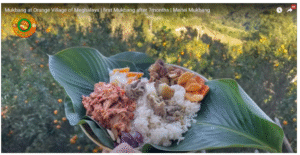 From migrant city hostels to Dalit hamlets to far-flung borderland villages (see Fig. 11: @Meitei Mukbang), these kitchens find ways to let their tastes seep back into the world, through screenshots saved, reels forwarded, old clips reshared, and e-invites for collective dining. If these small leaks do anything, they remind us that culinary memory – built on survival tactics, improvisation, and deep ecological habits – is hard to erase. A plate of pork stew or fermented soybeans carries not just taste but a story of how people get by when they are told to stay out of sight. These everyday recipes are more than meals; they are alternative knowledge systems that keep tribal epistemologies and Dalit consciousness alive on their own terms. The study contends that digital kitchens serve as dynamic counter-public archives, sanctioning marginalised food cultures to resist obliteration, validate identity, and nurture cohesion through everyday acts of sharing. They remind us that what was once called dirty or backward is, in fact, ancestral knowledge systems, intimate memory, and proof of how communities have always endured themselves amidst exclusion, discrimination, and crisis.
Together, these Dalit, tribal, and Indigenous digital kitchens remind us that survival can be collective and that when their tastes leak side by side, they feed not just memory, but solidarity.
1.6. Conclusion
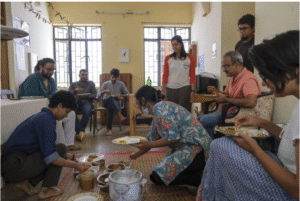
Fig. 12 – Potluck at Vamsi’s Interactive performance in Bangalore (Photo Credit by Vivek M: https://thelocavore.in/sri-vamsi-matta-come-eat-with-me/ )
Across each case, whether it is Vamsi’s potluck theatre, Rajyashri Goody’s edible archives, The Big Fat Bao’s Instagram feed, or the vernacular mukbangs from the borderlands of Northeast India, food becomes a medium through which alternative knowledge of survival enters the digital realm. What unites these dispersed practices is their use of the digital kitchen, a grassroots, multi-sited space where food, memory, and technology intersect.
The digital kitchen acts as a grassroots infrastructure of resistance. It operates at the porous intersection of Web 2.0 shareability and multimodal art practice – where cooking becomes coding, and eating becomes archiving. Here, posts, performances, and mukbangs constitute what Nancy Fraser (1990) calls counter-publics: discursive arenas where subordinated groups invent and circulate oppositional interpretations of their lives. It is at this point that it becomes imperative to recall Catherine Squires’ (2002) reminder: some publics also remain enclaved, retaining intimacy, secrecy, and an affective community within the act of sharing. The digital kitchen occupies this tension: both an outward-facing counter-public that contests Brahminical and nationalist food imaginaries, and an inward, community-based enclave of care, healing, and remembering.
Together, these practices turn the digital kitchen into a multi-sited pedagogy of survival, mobilizing Dalit consciousness and Tribal epistemologies. What leaks through these screens are not only recipes but methods of knowing otherwise (see Fig. 13) – forms of consciousness and epistemology that persist despite erasure, adapting to infrastructures that were never designed for them. They are not archives of the past but blueprints for collective futures, where food becomes a language of endurance and solidarity.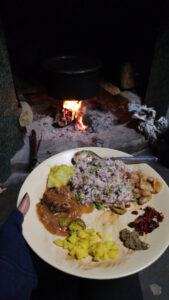
Fig. 13- A meal under the kitchen heart at Kohima’s Morung Lodge (self-photographed)
Declaration: All screenshots and visual materials used in this paper are drawn from publicly accessible platforms such as Instagram and YouTube, and are used solely for academic and non-commercial research purposes under fair use provisions. No private or restricted content was accessed, and care has been taken to contextualize the creators’ work respectfully within their socio-political frameworks.
Notes:
- Mukbang, a portmanteau of the Korean words meokja (“let’s eat”) and bangsong (“broadcast”), originated in South Korea in the late 2000s and rapidly evolved into a global digital phenomenon.
- Inspired by Ambedkarite scholarship, including works of Yogesh Maitrey, Dalit consciousness refers to the collective awareness among Dalit communities of caste-based exclusion, stigma, and historical injustice. As an epistemic standpoint, it acknowledges that knowledge, culture, taste, and survival have been shaped by oppression (stemming from caste, poverty, and marginalization), and it asserts the right to narrate, reclaim, and produce knowledge on one’s own terms. In practice, this consciousness is visible in Dalit autobiographical writing, art, food politics, reclamation of taste, and digital self-representation.
- Tribal epistemology denotes the knowledge production rooted in Indigenous and Adivasi ways of life – their relationships to land, ecology, oral tradition, memory, communal practice, ritual, and sensory knowledge. Unlike dominant knowledge systems that standardize the empirical, the scientific, or the sanitized, tribal epistemology values embodied, sensory, relational, and affective knowledge. These knowledge practices foreground themselves and emerge from experiences of displacement, exclusion, memory, and survival that are produced from within those communities rather than imposed from without.
References:
Deboo, K. (2023, September 29). Recipes of Revolt and Resistance: Artist Rajyashri Goody Challenges Deep-Rooted Casteism. The Locavore. https://thelocavore.in/2023/09/29/recipes-of-revolt-and-resistance-artist-rajyashri-goody-challenges-deep-rooted-casteism/
Fraser, N. (1990). Rethinking the public sphere: A contribution to the critique of actually existing democracy. Social Text, (25/26), 56–80. https://doi.org/10.2307/466240
Goody, R. (2018). Eat with great delight [Exhibition]. Clark House Initiative. https://www.rajyashrigoody.com/eat-with-great-delight
Kikon, D. (2020). Fermenting modernity: Putting akhuni on the nation’s table in India. In K. Bhushi (Ed.), Food and power: Expressions of food-politics in South Asia (pp. 133–148). Cambridge University Press.
Maitrey, Y. (2014, September 06). Towards Dalit Consciousness. Round Table India. https://www.roundtableindia.co.in/towards-dalit-consciousness/
Punyashloka, R. (2022, August 11). Sri Vamsi Matta’s Come Eat With Me: Or, to be Dalit and eat. The Locavore. https://thelocavore.in/sri-vamsi-matta-come-eat-with-me/
Rege, S. (1998). Dalit women talk differently: A critique of ‘difference’ and towards a Dalit feminist standpoint position. Economic and Political Weekly, 33(44), WS39–WS46. https://www.epw.in/journal/1998/44/review-womens-studies-review-issues-specials/dalit-women-talk-differently-critique
Squires, C. R. (2002). Rethinking the Black public sphere: An alternative vocabulary for multiple public spheres. Communication Theory, 12(4), 446–468. https://doi.org/10.1111/j.1468-2885.2002.tb00278.x
Vaditya, V. Tribal Epistemology: Thinking Through And Writing Emancipation. Journal of Tribal Intellectual Collective India, 7(5), 32-43. https://www.ticijournals.org/tribal-epistemology-thinking-through-and-writing-emancipation/#:~:text=Tribal%20Epistemology%3A%20Thinking%20Through%20and%20Writing%20Emancipation,-Published%20On%3A%20Friday&text=The%20process%20of%20knowledge%20creation,domination%20including%20the%20epistemic%20one.
Farmer Hepao Kuki. (2025, March 22). Prepare pork belly and eating in Jungle [Video]. YouTube. https://www.youtube.com/watch?v=-rCQ7l7_2Ro
Meitei Mukbang. (2023, December 3). [Video]. YouTube. https://www.youtube.com/watch?v=_KLfSu4kWqg&t=21s
@thebigfatbao. (2021, May 27). Caste and Food #1 [Video]. Instagram. https://www.instagram.com/p/CPWQegyJ78A/?hl=en
@eugene_ke_cuisine. (2025, May 22). Caste and Food #5 [Video]. Instagram. https://www.instagram.com/reel/DJ8E2HCPWfi/
@thebigfatbao. (2021, June 6). Caste and Food #1[Video]. Instagram. https://www.instagram.com/p/CPw-H_QJPS_/?hl=en
@thebigfatbao. (2021, July 24). Caste and Food #10 [Video]. Instagram. https://www.instagram.com/p/CQenri7JlVh/?hl=en
Bio-note: Sanskriti is a Doctoral Scholar at the School of Liberal Arts, Indian Institute of Technology, Jodhpur, India, working at the intersection of Media anthropology, Borderland studies, and cultural production in the borderlands of Northeast India. Her research interests include transnational media flows, piracy and informal distribution networks, indigenous food politics, and decolonial methods in media history. She also serves as a Junior Editor for the International Journal of Disney Studies.