The Centre for Studies of Plural Societies (CSPS) hosted a book discussion on Demography, Representation and Delimitation: The North-South Divide in India, authored by Dr Ravi K. Mishra, historian and Joint Director at the Prime Minister’s Museum and Library (PMML).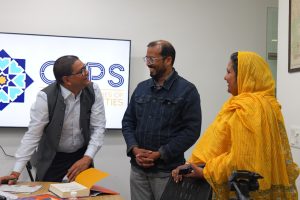
The session was chaired by Prof. Sanjay Kumar, political scientist and psephologist at the Centre for the Study of Developing Societies (CSDS), and featured Satya Prakash, Legal Editor at The Tribune, and Dr. Sajjan Kumar, political scientist and Founding Director of PRACCIS, as discussants.
Dr. Ravi K. Mishra opened the discussion by outlining the core argument of his book: that the debate on delimitation cannot be separated from India’s demographic disparities and the political consequences of representation. He traced the historical evolution of delimitation and argued that states which achieved demographic stability—particularly in the South—may ironically face political disempowerment under current frameworks.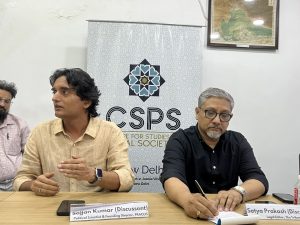
Prof. Sanjay Kumar emphasized the need for data-driven political analysis, pointing to the complexities of balancing federal equality with electoral representation. While the North-South divide is often understood in economic terms, he noted that its political implications, especially in the context of delimitation, demand deeper public engagement.
Satya Prakash examined the legal dimensions, highlighting constitutional amendments and judicial precedents. He raised concerns over potential litigation around questions of representation and equality if the delimitation process intensifies regional disparities.
Dr. Sajjan Kumar situated the debate in a wider political context, noting how narratives of national unity and justice often conflict when representation is at stake. He stressed that any delimitation exercise must be transparent and participatory to avoid worsening regional tensions.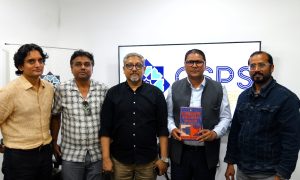
Audience participation added further depth, with questions focusing on the feasibility of extending the freeze on delimitation, the criteria for determining representation, and the political motivations shaping discourse around population and federalism.
The event brought together a range of perspectives on a subject of pressing national importance. By fostering a rigorous, multi-dimensional conversation, CSPS reaffirmed its commitment to advancing critical dialogue on pluralism, representation, and policy in contemporary India.