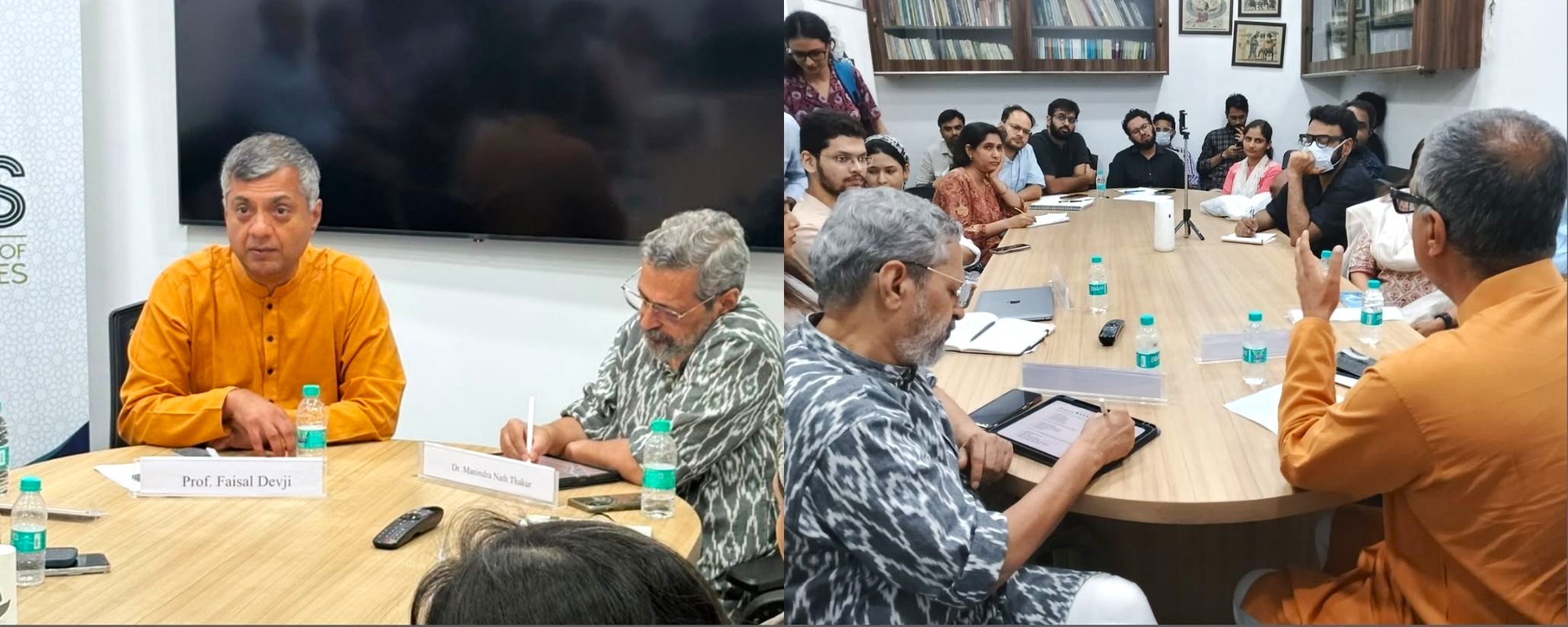
The Centre for Studies of Plural Societies (CSPS) hosted an enriching book discussion on Religion, Modernity, and the Global Afterlives of Colonialism, edited by Dr. Joshua S. Lupo and Prof. Atalia Omer. The
 session brought together students, scholars, and practitioners interested in the intersections of religion, postcolonial thought, and global modernity. The discussion aimed to unpack how the legacies of colonialism continue to shape religious identities, political imaginaries, and structural inequalities across different parts of the world.
Dr. Joshua S. Lupo, Assistant Director at the Contending Modernities Research Initiative, opened the conversation by outlining the intellectual motivation behind the edited volume. He highlighted that the book emerges from a sustained engagement with questions of how modernity—often perceived as secular, rational, and progressive—was historically co-produced with colonial violence, racial hierarchies, and missionary encounters. Dr. Lupo emphasized that the volume seeks to reframe debates on religion not as remnants of a pre-modern past but as lived traditions shaped through entanglements with empire, development discourse, and global governance. He underscored that the “afterlives of colonialism” are not merely historical residues but ongoing structures that define the possibilities of coexistence, justice, and pluralism today.

Prof. Atalia Omer, Professor of Religion, Conflict, and Peace Studies at the Kroc Institute, extended these insights by reflecting on how religious traditions frequently serve as sites of both resistance and complicity in relation to colonial and modern state formations. She discussed how the chapters in the book examine diverse cases—from Africa and South Asia to the Middle East and the Americas—to reveal how religious actors challenge neoliberal violence, environmental dispossession, and racial capitalism, while also sometimes reinforcing exclusionary politics. Prof. Omer stressed that understanding these dynamics requires a critical rethinking of modernity itself, acknowledging its imperial genealogies and the narratives of progress that often deny the experiences of marginalized communities. She emphasized that the book encourages scholars to interrogate how categories like “religion,” “secularism,” and “modernity” were shaped through colonial projects and thus continue to inform contemporary power relations.
The audience engaged actively with the speakers, raising thoughtful questions about comparative cases, the place of indigenous cosmologies in resisting extractive forms of modernity, and the challenges of researching religion in postcolonial contexts. Participants also discussed the implications of the book for understanding present-day global crises, including the resurgence of ethno-religious nationalism, challenges to pluralism, and ecological devastation shaped by colonial histories.

The session concluded with a collective appreciation for the editors’ contributions and CSPS’s initiative in creating a space for critical conversations on the intersections of religion, coloniality, and modern global structures. The discussion not only shed light on the analytical richness of the book but also encouraged participants to rethink inherited categories and confront enduring forms of inequality shaped by colonial afterlives.