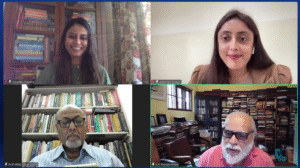
 The Centre for Studies of Plural Societies (CSPS) organised an insightful book discussion on Postcoloniality and Statehood: The Case of Egypt by Dr Priyanka Chandra on 14 November. Moderated by Dr Azeemah, the session brought together scholars and students to examine the historical, political and conceptual questions surrounding state formation in Egypt. Dr Azeemah opened the discussion by framing the book within broader debates on postcolonial transformation, noting how Egypt serves as a crucial case for understanding the tensions between colonial legacies, national sovereignty, and the pursuit of modern statehood. She highlighted the importance of interrogating how states inherit, reproduce and reconfigure systems of power, and emphasised that conversations like these help illuminate both regional specificities and wider global patterns.
As the author, Dr Priyanka Chandra, offered an overview of the key arguments developed in her book. She explained that the Egyptian state cannot be understood solely through the lens of authoritarianism, but rather as a formation deeply shaped by the administrative, financial and political structures embedded during British colonial rule. Dr Chandra discussed how Nasser’s postcolonial project attempted to reclaim autonomy through nationalism, agrarian reform and state-led development, while simultaneously consolidating centralised authority. She further analysed the transition to neoliberal authoritarianism under Sadat and Mubarak, as well as the ruptures and possibilities generated by the 2011 revolution. Her presentation underscored that Egypt’s trajectory reveals the enduring contradictions of postcolonial statehood—marked by aspirations for sovereignty on the one hand and entrenched systems of control on the other.
The Chair, Prof. A.K. Ramakrishnan (School of International Studies, JNU), situated the book within the wider field of postcolonial studies and modern West Asian political history. He argued that postcoloniality remains an ongoing condition rather than a historical endpoint, visible in the entanglements between global political economy, regional power structures and local governance practices. Prof. Ramakrishnan emphasised that Egypt’s political evolution—from monarchy to military rule, Arab nationalism and contemporary authoritarian consolidation—reflects larger struggles within West Asia over identity, resistance, and state legitimacy. He commended the book for integrating archival research with conceptual insight, offering a nuanced understanding of the Egyptian state beyond reductive stereotypes.
As the discussant, Prof. Aftab Kamal Pasha added a historical and geopolitical perspective, noting that Egypt’s experience cannot be seen in isolation from the broader Arab world. He highlighted the central role of
 the military in shaping Egypt’s political institutions and economy since 1952, arguing that understanding military dominance is essential for grasping the nature of the modern Egyptian state. Prof. Pasha also reflected on the book’s contributions to debates on political Islam, social movements and the influence of external actors such as the United States and Gulf states. He praised the work for foregrounding the lived experiences of Egyptians navigating state power, especially during moments of upheaval such as the 2011 revolution. His intervention enriched the discussion by situating Egypt within a wider comparative and regional framework.
The event concluded with an engaging Q&A session in which participants raised questions concerning the methodological challenges of studying authoritarian regimes, the implications of global financial institutions on domestic sovereignty, the legacies of colonial administrative structures, and the future of democratic aspirations in Egypt. The session reaffirmed CSPS’s commitment to creating spaces for rigorous discussion and critical engagement with issues of postcoloniality, state power and global politics.