Introduction
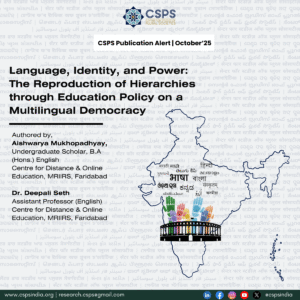 In a country where more than 19,500 mother-tongues and dialects are spoken, the language issue cannot only be described as cultural but rather political, pedagogical, and existential. Although the National Education Policy (NEP) 2020 of India is ambitious in its features of decolonizing education, revitalizing Indian languages, and democratization of access, re-triggers old wounds that have been submerged with the help of the anthropomorphic rhetoric of nationalism and development. Language can be presented as a field of empowerment and a zone of power struggle in a multilingual democratic world. The discussion in this commentary, the NEP 2020 is questioned and scrutinized to examine how this education policy construction frames language learning. It examines the way in which the colonial linguistic hierarchies have influenced policies in the postcolonial era, and how English and vernacular languages become placed in the new politics of access and exclusion, and how post-spoken anxieties over epistemic sovereignty, identity, and belonging in a dashed-up republic find their way into the discourse of policy.
Colonialism’s Lingua Fracture
The colonial adventure in India was never just about land and labour, and resources, but was also an epistemic conquest. Colonization starts, as it was written by Ngũgĩ Wa Thiong h, as soon as you remove all forms of language spoken by a given people and then you substitute your own. The notorious Minute on Indian Education in 1835 by Thomas Babington Macaulay institutionalized the use of English as the new power language and produced a new breed of anglicized Indians who were cut off their system of knowledge and lost touch with the masses. This was not a change of medium only – it was a civilisational caesura. Not only linguistically but also culturally entrenched in languages (such as Sanskrit, Tamil, Persian, Urdu, and Prakrit, among others) the Indian knowledge system subsumes not only philosophy, mathematics, linguistics, astronomy, medicine, and metaphysics. Having English as the only channel to modernity, all these traditions did not merely go unnoticed, but were made unreadable. This was followed by internalizing linguistic inferiority which has been adopted to date as well as a coloniality of knowledge that has been adopted even to date.
NEP 2020: As A Tool of Decolonisation
NEP 2020 boasts of severing this colonial legacy by stressing the proliferation of mother tongues and regional language, more so among early childhood education. It brings back the three language formulae, stimulates generation of regional scientific and literary material as well as translation of foreign knowledge to regional dialects. On the ground, it looks at inclusion, epistemic justice, and diversity of language. There is right behind this mask a great contradiction. As it promotes that the Indian languages are the primary means of language, NEP 2020 is not clear on how it will structurally empower these languages in the system in which English is the language of opportunity. English is never dislodged in the pursuit of its mission to become intellectually competitive and digitally empowered in the world; it is simply bracketed. The cascade of hierarchy has not changed; English on the high, the vernacular on the low and the rural and marginalized.
The English-Vernacular Dichotomy
It is a perilous reductionism with the presentation of the debate as that between English and vernacular. English ceased being a colonial imposition, but has become a creolized, mixed, and disputed language in India. It has been domesticated, politicized, and re-claimed by Dalit writers, feminist scholars and minority activist who thwart it as a means of subversion and exposure to a stratified linguistic society. At the same time, the term vernacular is misleading in itself; it is over-used, as a synonym, to caste-written, regionally dominant languages, which in their turn can turn exclusive. As an example, the policy of imposing Hindi as a national connective language alienates the Dravidian languages; the emphasis on Sanskrit revives the Brahmanical elitism; disregard of Urdu blanks out a lucrative literary and syncretic culture. This then begs the more important question: which language to support;
whose language to lend epistemic authority? In what can one regard as knowledge? And which language is good enough to take a classroom?
Linguistic Minorities and the Politics of Erasure
India is not a symmetric multilingual state. It is a hierarchy serving as caste, class, region, religion, and historic violence. Its majoritarian perspective is reflected through the fact that the NEP does not mention linguistic minorities, especially tribal languages (Adivasi tongues), Urdu speaking Muslims, and communities residing in borderlands. It is a type of language, underrepresented in the curriculum and stigmatised, in the sense of backward, impure, politically threatening. An example would be the Urdu, which was once considered the lingua franca of North India, has been ghettoized as Muslim and there has been a systematically phased attempt to wipe-out educational and institutional base of the Urdu. Such languages as Gondi, Santali and Bhili, contain centuries of oral and ecological knowledge and they often remain totally omitted in curriculum design. Thousands of people are being treated this way, not out of neglect but epistemic genocide. Census 2011 indicates that India has more than 19,500 languages/dialects, but NEP 2020 selectively advances Hindi and Sanskrit language without giving any attention to tribal and Urdu languages. This has seen the decline of Urdu-medium institutions and the further eradication of Adivasi languages such as Gondi and Bhili out of the curriculum.
Epistemic Inclusion: Beyond Multilingual
Epistemic inclusion does not quite involve sprinkling some Sanskrit words or translating science books into Hindi. It entails revolutionary reorganization of knowledge systems- to acknowledge that Dalit, tribal and Islamic knowledge-traditions are not additions to the knowledge-tradition but knowledge per se to critique the canon of knowledge that is Euro-centric. Colonized education does not only mean language, but it is the rethinking of pedagogy. It implies incorporating oral traditions, folk epistemologies, narratives, and local cosmologies in the curriculum. It entails the breaking up of notions that English is equal to science, and vernacular is relevant as culture. It translates into the idea that language should not be taken as a means of delivery, but rather a form of cultural-political action. We need to go beyond the epistemologies of the North by shifting towards the epistemologies of the South not by discarding the modern knowledge, but through an effort to pluralize the said knowledge.
The Inconvenience of English: A New Hegemony
In the present-day India, ironically English has ceased being only a colonial remnant it has become a neoliberal gatekeeper. The accessibility to tertiary institutions and tertiary education, online communication, and the global economy is increasingly done through English. This forms a paradox: on the one hand, vernacular languages provide a sense of identity and sense of place but on the other hand, vernaculars frequently cause a lack of economic mobility. In the meantime, English provides the access, though making it at the expense of alienation. The outcome is linguistic caste system: English speaking upper-middle classes and urban elites, Hindi or regional languages speaking rural and lower castes, and the total invisibilities of minority and tribal languages. Furthermore, it is not only education where English dominance is used as the primary language. The job search sites, job recruitment websites, government websites, and even redressal of grievances systems run increasingly on the English-only basis, further disenfranchising the already disenfranchised.
Grassroots Resistance and Linguistic Justice Movements
Although it is a process of erasure, communities have been opposing this. Tribal languages have been revived and documented by groups of socially-conscious people like the Bhasha Research and Publication Centre (Vadodara). Dalit authors such as Kancha Ilaiah Shepherd have composed coruscating judgments of Brahmanical domination of language. Such initiatives as Ekalavya and Multilingual Education Projects in Odisha and Chhattisgarh have tried to develop mother tongue-based learning resources in tribal areas of children.
The increasing awareness is also being expressed that, language justice forms the core of social justice. According to Dr. G. N. Devy, we have lost an entire worldview when we lose a language. The loss of language is not only the linguistic death of a language but also a civilizational death.
Conclusion: Whose Knowledge? Whose Language? Whose Future?
Missing opportunity of NEP 2020 is not that it does not speak about language, but that it does not politicize language. Language has nothing to do with education on a sidenote; language is the source of power, identity, and access. Without democratization of language we shall never democratize education. To salvage the pluralist vision of India, we need to cease to view language as medium and begin to view it as locus of justice. Then and only then education can become more than a ladder of upward mobility, it can become a means to dignity, memory and to freedom.
It is important to note that the language is not the obstacle to development, but segregation is. Development should have a language of the people, not the aristocracy.
References
- Devy, G. N. (1992). After Amnesia: Tradition and change in Indian literary criticism. https://ci.nii.ac.jp/ncid/BA37902788
- Grimshaw, A. D., & Gupta, J. D. (1971a). Language Conflict and National Development: Group Politics and National Language Policy in India. American Sociological Review, 36(5), 947. https://doi.org/10.2307/2093731
- Grimshaw, A. D., & Gupta, J. D. (1971b). Language Conflict and National Development: Group Politics and National Language Policy in India. American Sociological Review, 36(5), 947. https://doi.org/10.2307/2093731
- Ilaiah, K. (1996). Why I Am Not a Hindu: A Sudra Critique of Hindutva philosophy, culture and Political economy. http://www.stree-samyabooks.com/FileDownload.aspx?FileName=Why%20I%20Am%20Not%20A%20Hindu.pdf&&FilePath=~/UploadPDF/77.pdf
- Johnston, C. (2012). The Political Art of Patience: Adivasi resistance in India. Antipode, 44(4), 1268–1286. https://doi.org/10.1111/j.1467-8330.2011.00967.x
- Kamoche, J. G., & Thiong’o, N. W. (1987). Decolonising the mind: The Politics of Language in African literature. World Literature Today, 61(2), 339. https://doi.org/10.2307/40143257
- Macaulay, T. B. M. B., & Young, G. M. (1935). Speeches by Lord Macaulay, with his minute on Indian Education. http://ci.nii.ac.jp/ncid/BA66068712
- Mohanty, A. K. (2010). Languages, inequality and marginalization: implications of the double divide in Indian multilingualism. International Journal of the Sociology of Language, 2010(205).
- https://doi.org/10.1515/ijsl.2010.042
- Sengupta, P. (2017). Language as identity in colonial India: Policies and Politics. Springer.
- Teese, R., Lamb, S., & Duru-Bellat, M. (2007). International Studies in Educational Inequality, Theory and Policy. Springer Science & Business Media.
- Wyse, J. P. (2015). Epistemologies of the South: Justice against Epistemicide. Contemporary Sociology a Journal of Reviews, 44(6), 843–845. https://doi.org/10.1177/0094306115609925nn
Author Bio: Aishwarya Mukhopadhyay is an undergraduate scholar studying at Manav Rachna International Institute of Research and Studies, with academic interests that span literature, history, global affairs, and political thought.
Dr Deepali Seth is an Assistant Professor at the Centre for Distance and Online Education, Manav Rachna International Institute of Research and Studies.