Taqseem hua mulk, to dil ho gye tukde. 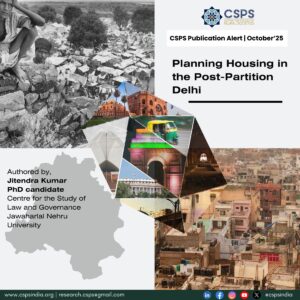
Har seene me toofan; wahan bhi tha yahan bhi.
Har ghar me chita jalti thi; lahrate uthhe sholay.
Har shahr me shmshan; waha bhi tha yaha bhi.
(The land is divided, lives are shattered.
Storms rage every heart; it’s the same here and there.
Funeral pyres in every home; the flames mount higher.
Every city is deserted; it’s the same here and there.)
The Partition of 1947 brought fundamental changes in the landscape of South Asian cities. The post-Partition resettlement and rehabilitation resulted in a nuanced manifestation of spatial segregation in the urban areas, shaped along the communal lines by the postcolonial bureaucratic governance. It is this kind of segregation that sometimes, even today, leads to outbursts in the form of communal violence in the cities. One of the most crucial spaces that became the site of state regulations and urban planning was the city’s housing. This essay explores how the housing became an important sphere in the city for urban spatial regulation and bureaucratic violence. In the post-Partition period, it was the homes of Delhi, in this case, where the postcolonial state forged the questions of urban planning, citizenship, and nationalism during the early years of the post-Partition period.
Delhi before Partition was considered as an “Indo-Islamic city” since it was the center of power during the times of the Delhi Sultanate and Mughal rulers. The city was also a center of Indo-Islamic and Sufi culture. Even during the colonial period, several havelis, mosques, bazaars, dargahs, Imambaras, and religious shrines defined Old Delhi’s landscape. Everyday life- both secular and religious- of the residents was carried out around these spaces (Yong and Kudaisya, 2002).
After Partition, thousands of refugees from West Punjab and Sindh, displaced by communal violence and fear, started pouring into Delhi. The city was also engulfed in one of the worst communal violence. The population in Delhi in 1947 was approximately 9.5 lakhs (9.18 lakhs according to the 1941 census). After Partition, 3.3 lakhs of the Muslim population were displaced. During this time, the city also witnessed the highest demographic growth in its history. According to the 1951 census, Delhi’s population was 17.44 lakhs, marking a 90 per cent increase since the census of 1941 (Dupont, 2004). During the 1950s, demographically, politically, and culturally, Delhi had become a “Partition City” (Pandey, 2001).
Housing became one of the major immediate concerns for the Partition refugees. During the Partition violence, houses and makan of the Muslims in the city became the center of violence. Often, the incoming Partition refugees or immigrant groups occupied the locked houses, sometimes pushing Muslims out of their homes. According to an estimate, almost 40,000 Muslim houses were occupied in Old Delhi alone by the incoming refugees (Yong and Kudaisya, 2002), who themselves had lost almost everything and were victims of communal violence on the other side of the border. There were organised attacks on the Muslim houses in the area of ‘mixed localities’ such as Karol Bagh, Subzimandi, and Paharganj. Around 100,000 refugees occupied the houses in these areas (Geva, 2017).
Post-Partition period heralded a new phase of bureaucratic violence in the city. The government passed the Evacuee Property Act in 1950, which declared the houses left by the Muslims as evacuee property. A new office of the Custodian of Evacuee Property was created to manage these properties. This act also ensured that the refugees illegally squatting these houses could not be removed for up to two years unless the government provided them with alternate accommodations. Selling homes by the Muslims before evacuating was not permitted. If one bought property from an intending evacuee, the government could declare the purchase void. Evacuee properties could only be purchased legally from the government. This bureaucratic regime was a subject represented in Balraj Sahni’s film Garm Hava, directed by M.S Sathyu and released in 1973. Set in Agra, the movie revolves around Muslim family, depicting how Salim Mirza faces bureaucratic harassment while struggling to save his ancestral haveli from the Custodian Office.
When the communal violence diminished, thousands of Muslims returned to Delhi. Many had migrated to Pakistan, while several others fled to refugee camps during the communal violence. Upon returning to the city, they found their houses had either been occupied by the refugees or declared as the evacuee property. They became homeless and their citizenship became suspicious. They found themselves trapped in the bureaucratic web to claim their own houses.
To regulate the influx of returning Muslims, the Government of India introduced the ‘permit system’ in July 1948, a tool in the hands of administration for surveillance and harassment of the minorities. The passport system, which replaced by the permit system in 1952, was used to curtail this immigration and to discipline the Muslims in the public sphere of North India. (Zamindar, 2007). In the post-Partition period, their rights over their own property became questionable in the eye of the state, even their citizenship and their movement became the subjects of continuous surveillance. These forms of bureaucratic violence and state surveillance continued in Delhi and in the whole North India, especially during the 1950s. These civic and bureaucratic violence played a crucial role in shaping the housing and residential spaces in Delhi. This further led to the dispossession of Muslim minority and shrinking of their housing and in spatial presence in the city. This process culminated in the development of designated “Muslim zones” in Delhi. These zones became the subject of policing and encroachment by the bureaucracy.
At the same time, the urban areas of Delhi underwent a large-scale expansion. The city had experienced an unexpected migration since the Second World War. The city served as the headquarters of Allied operations against Japanese in Burma and a supply base for the second front in China. This caused an influx of soldiers passing through Delhi, along with growing number of bureaucrats, which required the construction of housing to accommodate them. Several temporary and permanent houses and buildings came up during the war period (Datta, 2019). However, the wartime had already created a shortage of houses and infrastructure in the city. After 1947, Delhi witnessed a large-scale the housing problems resulting from the influx of the Partition refugees. The postcolonial government responded by planning institutions, space, and managing the resources to designed to gain “orderly” growth in the capital city (Datta, 2019). During the chaotic years of Partition, the government used refugee rehabilitation as a tool to gain control over the city. The Ministry of Relief and Rehabilitation was formed in September 1947, and the Delhi Municipal Committee (DMC), Central Public Works Department (CPWD), and Delhi Development Authority (DDA) were deployed in order to rehabilitate the Partition refugees. The postcolonial government began one of the biggest housing projects in Delhi to house the Partition refugees. More than 19,589 new housing units were built for the Partition refugees in Delhi by 1950, with 48,000 additional refugee accommodations planned. The European architect, Otto H. Koenigsberger, played a crucial role in post-Partition urban planning in Delhi. The government provided these houses to refugees at a very affordable price. It was the part of the larger state welfare project in housing sector by the government. (Riggs, 2024).
The post-Partition decades in Delhi witnessed the rise of Punjabi communities who once came as the refugees from the other side of the border. They has lost homes, properties, and neighbours. Many of them began their lives as residents of the refugee camps, while others were allotted evacuee houses. They depended on earning their livelihood by selling goods on pavements and in small shops. They contributed to the ‘Punjabification’ of Delhi in demographic and cultural terms. The Punjabi refugee colonies, such as Karol Bagh, Malviya Nagar, Kalakaji and others emerged as the most commercialized space and elite residential places over the period of times. It became the symbol refugees’ industriousness, and center of the identity of Delhi’s’ urbanism.
However, these housing projects and resettlement, which were the product of post-Partition urban planning, reproduced the pre-Partition inequalities along the communal, class, and caste lines. The post-Partition bureaucratic violence pushed the minorities on the margins of urban space and public sphere of the city. Their houses and neighborhoods became the sites of suspicion and the subject of state surveillance. The stories of loss and trauma of losing homes is still not part of the dominant Partition narrative. The history of how the homes of minorities on both sides of border, India and Pakistan, were lost during the Partition, and trauma caused by this requires further investigation. Several stories of Partition history are still the stories of silence.
References:
Datta, Anjali Bhardwaj. “Genealogy of a Partition City: War, Migration and Urban Space in Delhi”. Journal of South Asian Studies, Feb 2019, pp. 1-18.
Dupont, Véronique. “Socio-spatial differentiation and residential segregation in Delhi: a question of scale”? Geoforum, Volume 35, Issue 2, 2004, pp. 157-175.
Erin, P. Riggs. A Contemporary Archaeology of Post-Displacement Resettlement: Delhi’s 1947 Partition Refugee Homescapes, Routledge, New York, 2024.
Geva, Rotem. “The Scramble for Houses: Violence, a functionalized state, and informal economy in post-partition in Delhi”. Modern Asian Studies, 51,3 (2017), pp. 769-824.
Pandey, Gyanendra. Remembering Partition: Violence, Nationalism and History in India. Cambridge University Press, 2001.
Sathyu, M.S. Garam Hava. 1973. (https://www.youtube.com/watch?v=eHfrHDBxCFU)
Tan, Tai Yong and GyaneshKudaisya. The Aftermath of Partition in South Asia. Routledge Publication, London, 2002.
Zamindar, Vazira Fazila-Yacoobali. The Long Partition and the Making of Modern South Asia: Refugees, Boundaries, Histories. Columbia University Press, New York, 2007.
Author Bio: Jitendra Kumar is a PhD candidate at JNU, New Delhi. He is working on the history of urban planning, citizenship, and property relations of post-Partition Delhi