The Centre for Studies of Plural Societies (CSPS) organised a book discussion on Framing the Media by Pamela Philipose, a sharp and timely examination of the role of media in shaping public opinion, sustaining power, and contesting democracy in contemporary India.
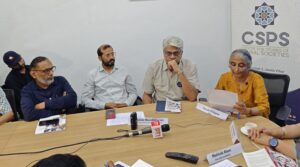
The session was chaired by Sukumar Muralidharan, an 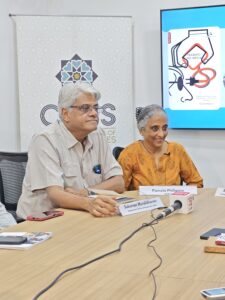
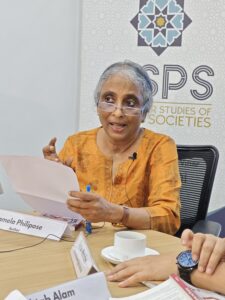 independent writer and researcher, who framed the discussion by underlining the historical role of media in democratic life and the growing concern around its complicity with political and corporate interests.
The panel featured Md Mahtab Alam, journalist and writer, and Suroor Mander, lawyer an
d human rights activist, as speakers. Together, they engaged with Philipose’s arguments on how the media is “framed” both structurally and ideologically—through ownership patterns, state regulation, and the often-subtle ways in which editorial priorities are shaped.
Md Mahtab Alam spoke about the changing character of newsrooms, where pressures of commercial viability and political alignment have weakened independent journalism. Drawing on his own experiences, he discussed the shrinking space for dissent and the risks faced by journalists reporting on issues of marginalisation, inequality, and human rights violations.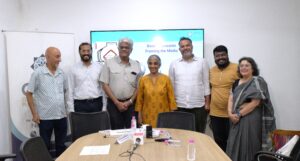
Suroor Mander brought a legal and activist perspective to the conversation, highlighting how media narratives not only inform public opinion but also influence judicial attitudes, policymaking, and state legitimacy. She underscored the dangers of media trials, the vilification of minorities, and the erasure of voices of resistance, arguing that these practices threaten the very idea of plural and democratic citizenship.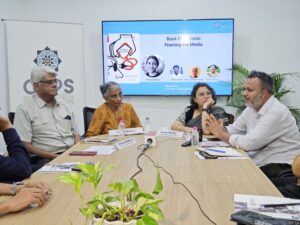
In his concluding remarks, Sukumar Muralidharan tied the discussion back to the larger political economy of media, stressing that the crisis is not merely about individual bias or ethical failure but about systemic control of information flows. He argued that reclaiming media spaces requires collective interventions, policy reform, and a reassertion of the journalist’s role as a public intellectual.
The discussion saw an engaged audience raise questions on issues such as the future of independent media, the role of digital platforms, and the potential of alternative media collectives. The event reaffirmed the urgency of Philipose’s book as both a critique and a call to action.
By bringing together practitioners, activists, and scholars, the session illuminated the layered relationship between media, democracy, and representation—reasserting CSPS’s commitment to creating spaces of dialogue on issues central to India’s democratic life.