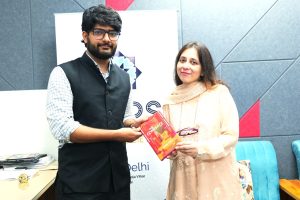
The Centre for Studies of Plural Societies (CSPS) hosted a compelling discussion on The Comeback, the latest novel by Annie Zaidi—an acclaimed author known for her incisive literary sensibility and engagement with themes of identity, memory, and social inequality. The event brought together writers, scholars, students, and literature enthusiasts for an exploration of the affective, aesthetic, and political dimensions of storytelling, situating the novel within contemporary socio-political realities.
The session was chaired by Anubha Yadav (Writer, Filmmaker, and Academic) and moderated by Dr. Ankita Saxena (Fellow, CSPS).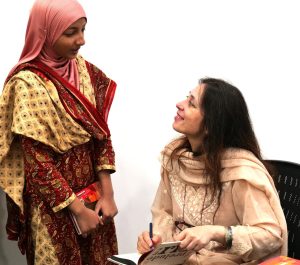
Dr. Saxena opened the discussion with remarks that positioned The Comeback as a literary meditation on the complexities of “return”—whether geographical or emotional. She drew attention to the novel’s ability to capture ambition, estrangement, and longing, while foregrounding the subtle emotional textures embedded in its characters’ lives.
In her reflections, Annie Zaidi walked the audience through the creative process behind the novel. She spoke of how memory, aspiration, and unresolved emotions shape the choices of her protagonist, noting that the act of “coming back” is always fraught with contradiction and unease. Zaidi elaborated on her use of minimalism and silence to express internal conflicts, offering a glimpse into the deliberate literary choices that define her craft.
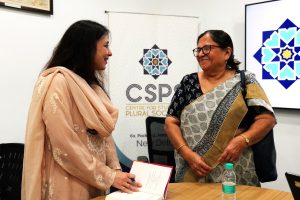 Anubha Yadav provided a critical reading of the novel, emphasizing its feminist undertones. She noted that Zaidi’s narrative resists grand or heroic arcs, focusing instead on quieter, intimate forms of resilience and resistance. Yadav highlighted how the novel’s female characters navigate morally complex terrains, revealing structural inequalities embedded in everyday life. She also argued that the novel’s introspective tone, deliberate pacing, and open-ended form serve as acts of political resistance, challenging conventional expectations of closure in storytelling.
Guiding the conversation further, Dr. Saxena raised questions of narrative ethics and the role of ambiguity in fiction. She drew attention to the way Zaidi’s work unsettles dominant cultural norms around success, belonging, and transformation, while also functioning as a mode of social critique.
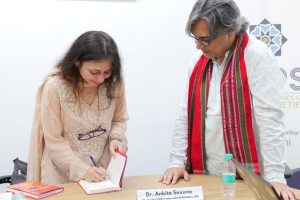
The audience engagement was dynamic, with participants posing questions that ranged from the autobiographical to the political. Discussions touched on the extent to which personal experience informs fiction, and how literature can serve as a tool for critique in an increasingly polarized society. Many participants reflected on the emotional resonance of the novel, acknowledging its ability to bring forth difficult truths about gender, power, and identity. Zaidi responded with thoughtfulness, offering both practical insights into the writing process and reflections on the ethical dilemmas writers face today.
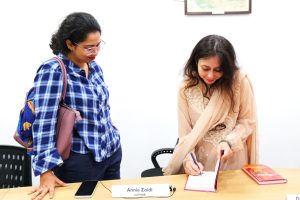 The discussion concluded with closing remarks from Dr. Saxena, who expressed gratitude to Annie Zaidi and Anubha Yadav for their thought-provoking engagement, and to the audience for their active participation. The event reinforced CSPS’s commitment to literature as a site of plural imagination, critique, and dialogue. By creating such spaces, CSPS continues to nurture conversations that bridge the literary and the political, enabling deeper engagement between writers, thinkers, and readers.