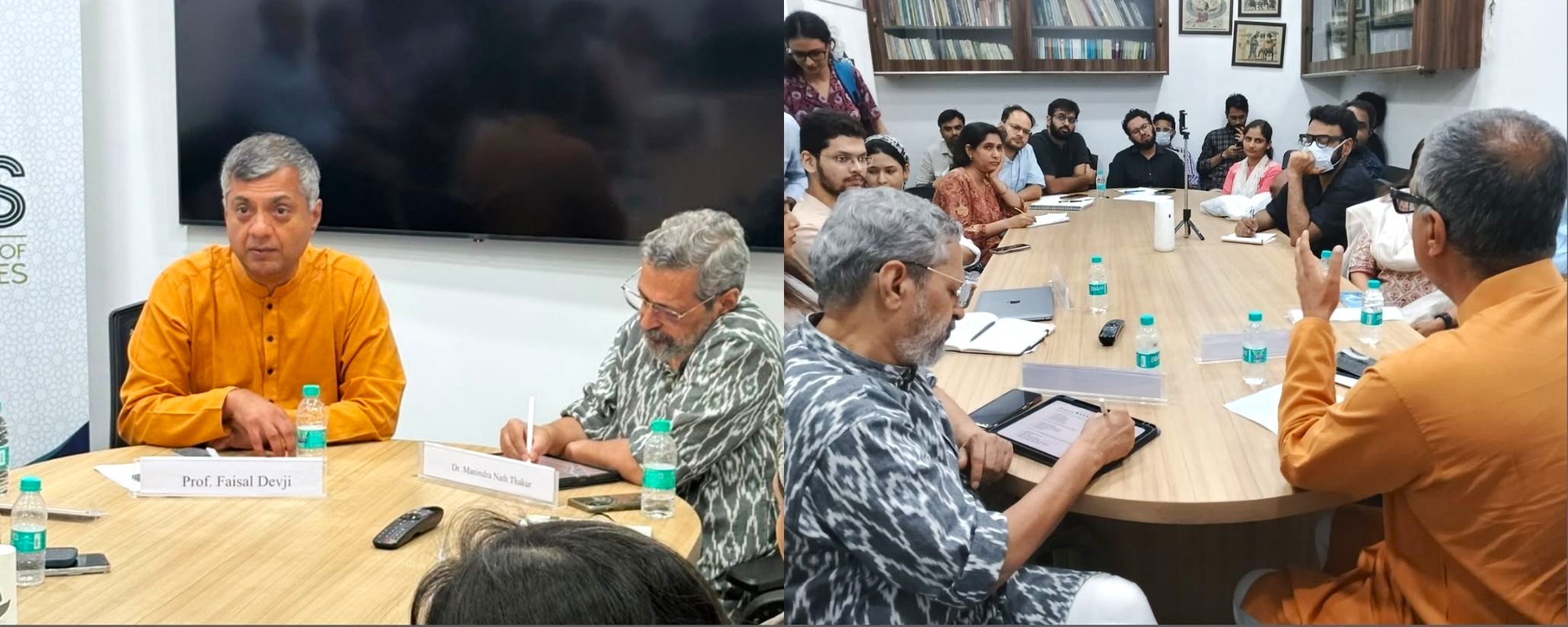
Centre for Studies of Plural Societies (CSPS) organised a book discussion on “Framing Identities: Post-Colonial Bollywood and Muslim Representation” authored by Dr. Nadira Khatun, an assistant professor at School of Communications, XIM University, Bhubaneswar, Odisha. The session was moderated by Nehal Ahmed, a Cinema Scholar at Jamia Millia Islamia.
Dr. Khatun commenced the session emphasising on how cinema in postcolonial worlds often function as a reflection of changing socio-political and cultural trends within society. She makes her case using quotations from multiple filmmakers and audience participants to give us a more nuanced and closer view of what processes lead to the creation as well as the consumption of cinema in certain ways. The discussion centred around how the eventual decrease of showcasing cinematic themes around Partition – and by extension communal politics and riots – on screen, was a way of overlooking the horrors of religious polarisation. Instead, simultaneously there seemed to be a later emphasis on the overrepresentation of Islamic terrorism that accompanies nationalist jingoistic cinematic productions.
The discussion included the author running the audience through the major chapters of the book segmented in a linear fashion, beginning with Post-Partition and Muslim involvement in filmmaking. She notes that actors and filmmakers were an integral part of the subcontinent’s filmmaking scene, which later became a ‘problem’ in the post-partition period leading to Muslim actors having to change their names to sound more ‘Hindu’, while paradoxically there was an emphasis on the social acceptance of Muslim representation and secular themes. The second part of the discussion centred around how Muslims were represented in ‘historical genres’ and how they went to be portrayed from ‘diplomat warriors’ to ‘foreign invaders’. With movies like ‘Jodha Akbar’ there was a positive stereotype and an exoticisation of ‘benevolent rulers’ which later metamorphosed into themes that imposed a ‘saffronised’ version of historical narratives – using cinema as a means to foster Hindu Nationalism. This also coincided with the outbreak of civil unrest at the time of the Citizenship Amendment Act protests. The author noted how in the 1960s there was an emphasis on the ‘secular warrior diplomat’ image of Mughal emperors as being intellectual, secular, a patron of the arts projected through live stories interwoven with ‘fictionalised’ history. However, in the contemporary era, the historical genre in Bollywood has become an ideological dialogue for a reinterpretation of a glorious Hindu Nationalist past where the Mughals are no longer the protagonists but the ‘foreign enemy of the nation’. This imaginary exoticisation of an ‘invading barbarian’ marked the sudden reappearance, after a brief period of disappearance, from the genre of historical cinema, that reflected public perceptions regarding Indian Muslims. This process of ‘retrospective fact generation’ was most often biassed and recreated a mythical fast akin to Foucault’s theory of ‘heterotropia’ such as in the cinematic depictions of the Maratha Empire. One such movie trailer was posted by the director on Twitter with the caption ‘Surgical Strike That Shook The Mughal Empire’ using the linguistic terms popularised by the politicisation of the 2019 Balakot air strikes against Pakistan. The character of Alauddin Khilji similarly has been denigrated into films without any nuance of the historical figure to paint an alternative discourse around the politics of ‘Love Jihad’, as reflected in the controversies surrounding the movie ‘Padmaavat’ and ‘Manikarnika: The Queen of Jhansi’.
Dr. Khatun also noted how other filmmakers in the genre she terms as ‘Muslim political genres’ have had to face censorship, such as when the director of the movie ‘Zakhm’ was asked to digitally change the colour of ‘saffron bands’ that was worn by goons in the film, leading to an instance of the State dictating arts and crafts and the performance of free speech. The discussion also focussed around the portrayal of the ‘Ideal Family’ within a Hindu Nation which represented the ‘standard Indian culture’ that other-ised all other forms and types of a ‘family. When characters from other communities were depicted, they were done so in a subordinate position to the ‘majority’ in a subservient position devoid of identity or individuality. Following 9/11, the Babri Masjid demolition and the Mumbai riots, Bollywood representation of Muslims turned to focus towards the ‘Muslim gangster’ engaged in ‘terrorist activities’. The author divides this phenomenon into three variants: firstly relating to Kashmir, secondly regarding communal events across the country following the Mumbai riots and thirdly following 9/11. In these films, such as ‘Roja’, the cinematic ‘enemy’ becomes a Kashmiri militant that is also meant to denote the image of a ‘terrorist’ applicable to any Muslim. This intertwining of Indian Muslims and Pakistan leads to a conflation of who the ‘Enemy of the Nation’ is supposed to be. Even in movies where Bollywood does place a Muslim character as a protagonist, such as in ‘Zindagi Na Milegi Dobara’, they are devoid of any symbolism or identity connecting them to their faith, ignored to make clear that their ‘allegiance’ to the nation is intact. The book also talked about how Muslim women characters in Bollywood movies, such as in movies like ‘Secret Superstar’ and ‘Gulley Boy’, were portrayed. In these the plight of Muslim women were highlighted along with the specific targeting of Muslim men as the primary oppressor. This meant the overused depiction of polygamy among Muslims while creating a binary between ‘traditional conservatism’ and ‘progressive modernity’, with the latter being heavily based on ‘western morality’.
The discussion also saw relevant questions from the audience that reflected about whether there were portrayals of the differences of Muslim communities such as Shias and Pasmanda Muslims as well as how movies tended to focus less on issues like about poverty and inequity. The discussion concluded with a note about how even cinematic narratives post-Partition, especially at a period of heightened communal polarisations, tended to be guided by a conscious effort of the State and filmmakers to emphasise on secularism given the ongoing communal violence at the time of Independence and the forging of a new nation. This might have been borne out of the larger socio-political trends of Nehruvian socialism that was prevalent in the state apparatus and industries like Bollywood. It was also noted that cinema does hold a responsibility, but within a capitalist system and a market-driven economy, its autonomy has shrunk while hegemonic forces have capitalised on swaying audience cravings while being backed by a political dispensation that is all too eager to portray narratives a certain way. The book represented an important part of analysing how changing socio-political currents shape the world around us and the multiple realities we seem to inhabit and provides a means for us to evaluate how narratives and emotions percolate through different layers of society.
The report is prepared by Callistine Lewis, a research intern at CSPS.