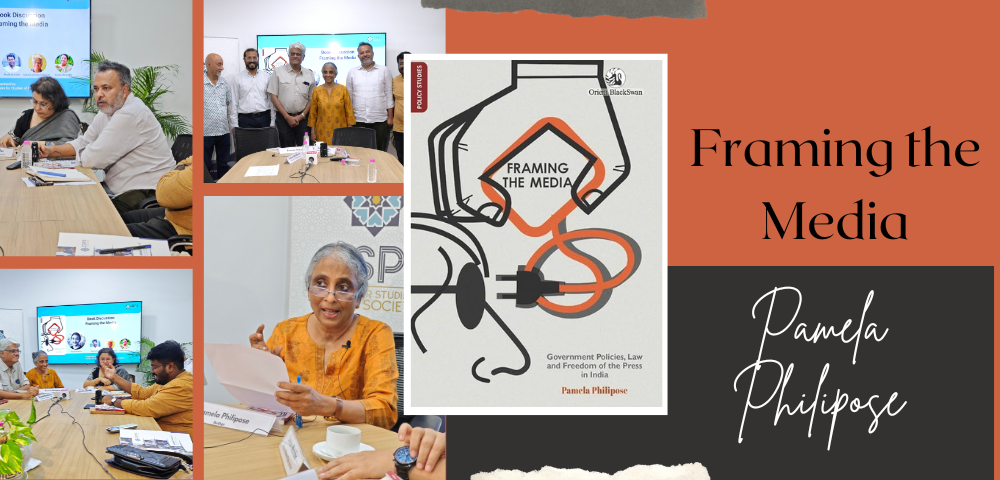
 On 1 September 2025, the Centre for Studies of Plural Societies (CSPS), in collaboration with Orient BlackSwan, hosted a stimulating discussion on Framing the Media: Government Policies, Law and Freedom of the Press in India by journalist and scholar Pamela Philipose. The event was part of CSPS’s ongoing commitment to critically examining questions of democracy, representation, and plurality in contemporary India.
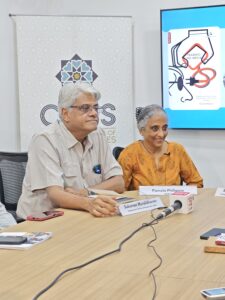
The conference room at CSPS was filled with scholars, journalists, students, and civil society practitioners, all eager to engage with urgent debates around the state of media freedom. The session was chaired by Sukumar Muralidharan, independent writer and researcher, and featured two distinguished discussants: Md. Mahtab Alam, journalist and writer, and Suroor Mander, lawyer and human rights activist.
About the Book
Pamela Philipose’s book Framing the Media is a timely intervention that interrogates the relationship between state power, regulatory mechanisms, and the media landscape in India. Written with the precision of a seasoned journalist and the depth of a scholar, the book uncovers how government policies and legal frameworks—both historical and contemporary—have framed the boundaries of media freedom.
Philipose illustrates how media, far from being a neutral observer, is deeply entangled in structures of power. She draws attention to key episodes in Indian history, from colonial censorship to the Emergency, and extends her analysis to contemporary challenges of ownership consolidation, advertising dependency, and the rise of digital platforms. Through these examinations, the book highlights how the state and market pressures often converge to undermine journalistic independence, while at the same time, new technologies create both opportunities and threats for the democratic role of the press.
Author’s Presentation
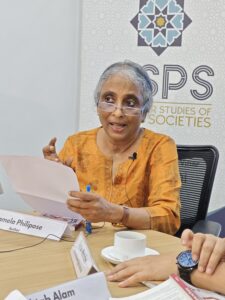
In her opening remarks, Pamela Philipose laid out the central thesis of her book: that freedom of the press in India cannot be understood merely in terms of legal protections but must be situated within the broader ecosystem of governance, ownership, and political culture.
She discussed how the framing of press freedom often oscillates between two poles—on one side, the state’s insistence on regulation in the name of security or morality, and on the other, the journalist’s struggle to assert autonomy. Philipose also highlighted the vulnerabilities of media institutions, particularly in relation to corporate ownership and advertising pressures, which frequently dictate editorial choices.
She emphasized that the “crisis of media” today is not confined to overt censorship, but extends to the more insidious erosion of independence through economic, political, and technological pressures.
Chair’s Reflections – Sukumar Muralidharan
Chairing the session, Sukumar Muralidharan contextualised the book within the historical trajectory of Indian journalism. He recalled the Emergency (1975–77) as a defining moment when the Indian press was confronted with state censorship on an unprecedented scale. While such overt interventions have become less common in recent decades, Muralidharan argued that subtler forms of control—through ownership structures, political patronage, and dependence on state advertising—have become more entrenched.
He also drew attention to the global dimension, noting that India’s struggles are not isolated but part of a larger global pattern where governments and corporations are reconfiguring the media to suit the imperatives of control, profit, and political legitimacy.
Discussants’ Perspectives
Md. Mahtab Alam
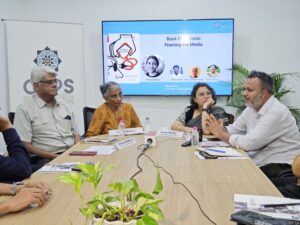
Alam brought the perspective of a working journalist. He spoke about the difficulties faced by reporters covering issues of communal violence, minority rights, and conflict zones. Citing personal experiences and field examples, he emphasised how laws such as sedition and anti-terror legislation are often used to intimidate and silence journalists. He argued that the media’s role as the “voice of the voiceless” is increasingly compromised when journalists are forced to practice self-censorship out of fear of reprisal.
Suroor Mander
Mander offered a legal and rights-based perspective, stressing the deep entanglement between law, media narratives, and justice. She observed how the media often reproduces systemic biases, especially against marginalised groups such as religious minorities, Dalits, and women. She noted that while legal frameworks formally guarantee freedom of expression, their interpretation and implementation often work to constrain dissenting or critical voices. Mander further pointed to the importance of alternative and community-based media that attempt to challenge dominant narratives and bring marginalised perspectives into the public sphere.
Audience Engagement
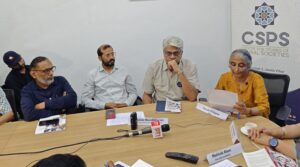
The event concluded with an engaging question-and-answer session, where participants raised pressing questions:
-
How do digital and social media platforms transform the landscape of press freedom in India?
-
What strategies can grassroots journalists adopt to resist corporate and state capture?
-
Can the legal system serve as a safeguard for press freedom, or does it remain an instrument of control?
-
How should scholars and civil society respond to the shrinking space for critical journalism?
The discussion underscored the tension between optimism about the democratizing potential of digital media and the recognition of its vulnerabilities to surveillance, misinformation, and corporate control. Both Pamela Philipose and the panellists stressed the need for vigilance, solidarity, and the cultivation of ethical journalism as counterweights to these challenges.
Closing Remarks
In her concluding words, Pamela Philipose reflected on the need to see journalism as a public good, vital to democracy. She urged younger journalists and scholars not to succumb to cynicism but to critically and creatively engage with media practices that challenge dominant narratives.
Sukumar Muralidharan, in his closing remarks, reiterated that the struggle for press freedom is ongoing and requires constant public engagement. He thanked the author, the panelists, and the audience for their insights and emphasised CSPS’s role in providing platforms for such critical conversations.
Key Takeaways
-

The struggle for press freedom in India is not confined to censorship but involves deeper structural challenges of ownership, regulation, and political influence.
-
The media plays a dual role: as a site of democratic contestation and as an instrument that can reinforce inequalities.
-
Legal frameworks offer both opportunities and constraints, depending on how they are mobilised by state and civil society actors.
-
Digital media provides new avenues for resistance but also creates vulnerabilities that need critical engagement.
-
Press freedom is inseparable from broader democratic struggles for rights, representation, and accountability.
Conclusion
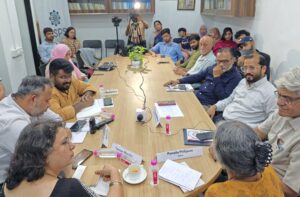
The discussion around Framing the Media reaffirmed that media freedom is central to the survival of democracy in India. The book and the panel brought to light the multiple ways in which the state, market, and law intersect to shape journalistic practice, often to the detriment of independent and ethical reporting.
By foregrounding these critical debates, CSPS once again positioned itself as a vital space for democratic dialogue and scholarship, committed to defending plurality and nurturing voices that challenge structures of power.