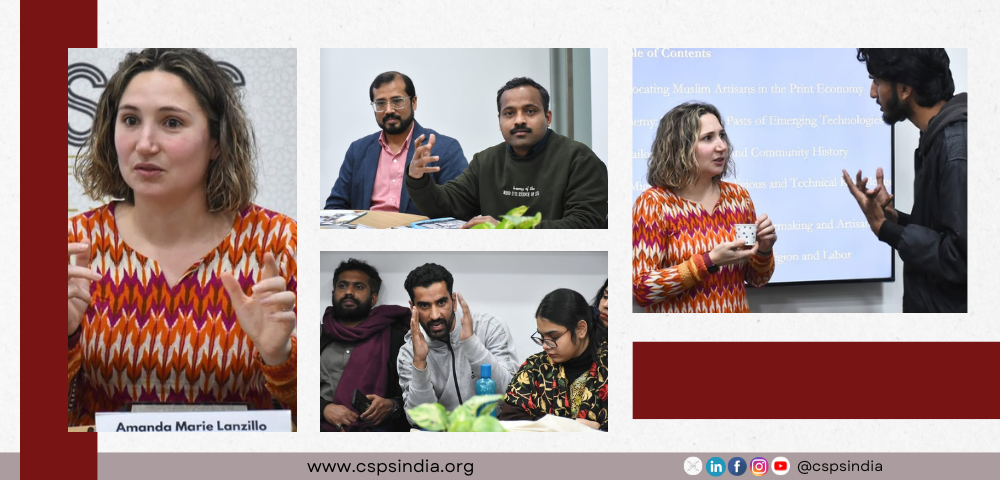
Th e Centre for Studies of Plural Societies (CSPS) hosted a deeply insightful and intellectually vibrant book discussion on Pious Labor: Islam, Artisanship, and Technology in Colonial India by Dr. Amanda Marie Lanzillo on 21st January 2025 at 4:00 PM. The event brought together scholars, students, and members of the public to explore the intersection of labour, religion, and ethics within the historical context of Muslim artisanal communities in colonial India.
Chaired by Dr. P.C. Saidalavi, Assistant Professor at the School of Humanities and Social Sciences, Shiv Nadar University, the session began with a thoughtful framing of the book’s intervention. Dr. Saidalavi emphasised that Pious Labor makes a powerful case for revisiting labour history through the lens of ethical practice and religious consciousness, challenging the prevailing secular-economic paradigms that dominate both historical and contemporary narratives of work.
Dr. Amanda Lanzillo, Assistant Professor at the University of Chicago, presented the central arguments of her book. She foregrounded how Muslim artisans—engaged in occupations such as metalwork, tanning, butchery, and tailoring—understood their labour not merely as a means of livelihood but as an ethical and spiritual commitment. Drawing on Islamic jurisprudence, Sufi traditions, and community texts, Dr. Lanzillo argued that these artisans perceived their work as a form of ibadah (worship), with an emphasis on cleanliness, honesty, humility, and moral responsibility. The talk traced how these
understandings were gradually transformed and eroded under colonial rule, as bureaucratic classification, census logics, and social reform movements sought to rationalise, stigmatise, or reconfigure Muslim artisanal identities and practices.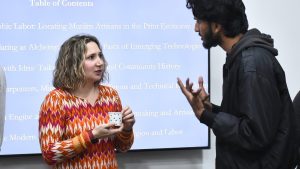
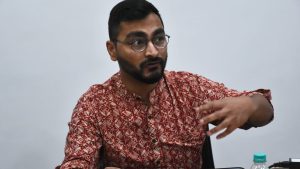
Responding to the presentation, Dr. Saeed Ahmad, Assistant Professor and Assistant Dean of Research at the Jindal School of Art and Architecture, OP Jindal Global University, offered a rich and expansive critique. He praised the book’s interdisciplinary methodology—its ability to stitch together archival depth with theoretical innovation and ethnographic sensitivity. Dr. Ahmad noted that Pious Labor moves beyond binaries of religious/secular or spiritual/material, and instead provides a textured account of labour as simultaneously embodied, ethical, and socially embedded. He also raised important questions around caste, gender, and the politics of purity, urging a deeper conversation on how such ethical frameworks of labour resonate (or clash) with the hierarchies that structure artisanal life across South Asia.
The discussion that followed was wide-ranging and intellectually stimulating. Attendees raised questions about the persistence of these ethical frameworks in contemporary India, especially in relation to informal economies, religious identity, and the shifting landscapes of dignity and value. The conversation also touched upon the methodological challenges of working with colonial archives, oral narratives, and community memory, and how these sources can be mobilised to recover marginalised voices and lifeworlds.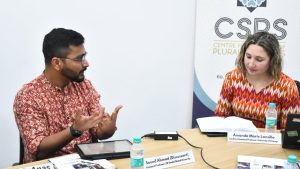
Dr. Saidalavi concluded the event by highlighting the book’s broader implications—not only for scholars of South Asian labour history but also for those interested in reimagining work as a site of ethical engagement and spiritual creativity. He reiterated that Pious Labor offers a vital and timely intervention, inviting us to rethink how we write about, value, and live with labour in both historical and contemporary terms.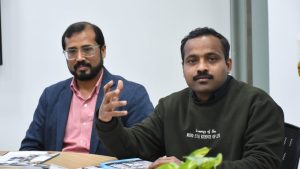
With 49 participants registered and 25 in attendance, the event marked another successful endeavour by CSPS to foster critical, plural, and interdisciplinary conversations around issues of social justice, historical memory, and ethical life. CSPS extends its gratitude to Dr. Amanda Lanzillo, Dr. Saeed Ahmad, and Dr. P.C. Saidalavi for their generous insights and participation. We look forward to continuing these crucial dialogues in the months to come.
—Mohammad Zaid